Uncrewed Surface Vessels (USVs), also known as unmanned or autonomous surface vessels, are increasingly used for oceanographic research, environmental monitoring, and offshore operations. These vessels offer a low-risk, cost-effective, and sustainable alternative to traditional crewed ships. In this article, we take a closer look at the core components of USV technology—focusing on power systems, sensors, and navigation capabilities—using the Sailbuoy as a case study.
Power Systems: Wind and Solar for Endurance and Efficiency
USVs rely on alternative energy sources to remain at sea for extended periods. One widely used approach combines wind and solar power, allowing vessels to operate autonomously for weeks or months.
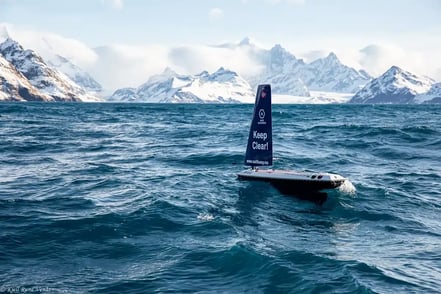
The Sailbuoy, for example, is a long-endurance USV that uses a wind sail for propulsion. This passive, mechanical sailing system minimises energy consumption while enabling consistent forward motion. To support onboard electronics, the Sailbuoy is equipped with solar panels that charge internal batteries. These power navigation, data logging, satellite communication systems, and sensor payloads.
This hybrid power design enables low-emission, long-duration missions—even in remote areas where conventional vessels would be costly or impractical to deploy.

Sensor Systems: Collecting Ocean and Atmospheric Data
One of the key functions of a USV is to carry sensors that collect data from the marine environment. The choice of sensors depends on the mission goals and deployment location. Common types include:
- CTD Sensors (Conductivity, Temperature, Depth): Used to characterize water properties.
- ADCPs (Acoustic Doppler Current Profilers): Measure current speed and direction throughout the water column.
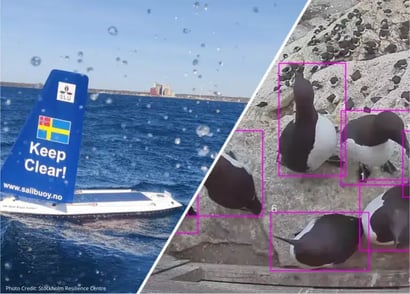
- Echosounders: Used for biomass estimation, seabed mapping, or habitat characterisation.
- Meteorological Sensors: Monitor air temperature, pressure, wind speed and direction.
- CO₂ and Oxygen Sensors: Track carbon flux and biological activity.
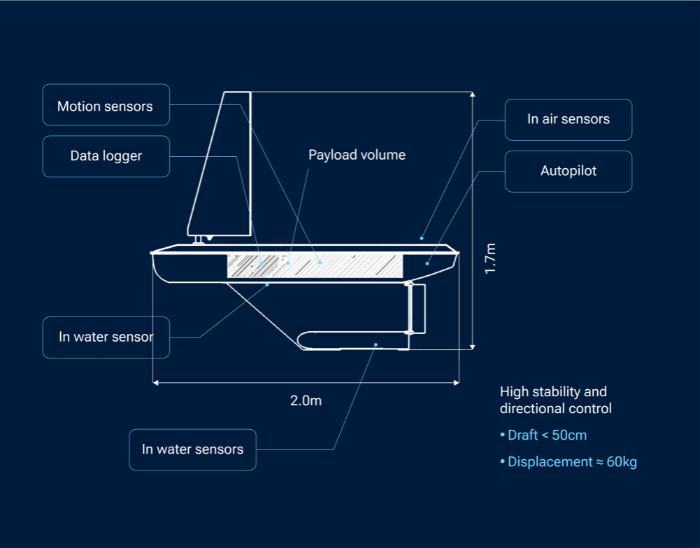
The Sailbuoy supports a modular sensor platform, which means users can configure the vessel for specific tasks, such as measuring ocean currents, tracking fish populations, or monitoring surface CO₂ concentrations. Sensors are integrated into the hull or attached externally, and data is either stored onboard or transmitted in near-real time via satellite.
Navigation Systems: Autonomy and Remote Control
Autonomous navigation is essential for USVs to complete missions reliably and safely. These systems typically include:
- GPS-based positioning systems for location tracking.
- Autopilot software that manages heading, speed, and routing.
- Satellite communication systems (e.g., Iridium) for remote mission updates, real-time data transfer, and status reporting.
The Sailbuoy uses a combination of GPS navigation and onboard autopilot to follow predefined waypoints or adaptive mission routes. Operators can monitor progress and make adjustments remotely without constant intervention.
The vessel is also designed to maintain **high stability and directional control** even in challenging sea states. With a draft of less than 50 cm and a displacement of about 60 kg, the Sailbuoy is lightweight, manoeuvrable, and easy to deploy from shore or ship.
Advantages of USV Technology
The integration of efficient power systems, adaptable sensor payloads, and autonomous navigation allows USVs to support a wide range of maritime applications:
- Climate and oceanographic research
- Fisheries monitoring and stock assessment
- Offshore infrastructure inspection
- Marine pollution and water quality surveillance
- Seabed mapping and coastal surveying
With their small environmental footprint and operational flexibility, USVs like the Sailbuoy contribute to **sustainable ocean data collection**, particularly in areas where traditional vessels would be resource-intensive or logistically difficult to deploy.
Conclusion
USV technology represents a significant advancement in marine observation. By combining renewable energy, modular sensor systems, and autonomous navigation, these vessels extend the reach of ocean monitoring while reducing costs and environmental impact.
The Sailbuoy provides a practical example of how such systems are being deployed today for real-world applications. They deliver critical data from the sea’s surface with minimal emissions and maximum efficiency.
For more technical information, visit:
Unmanned Surface Vessels Overview